
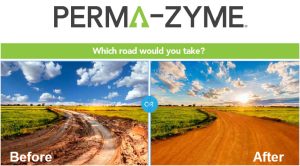
Road construction is an industry often stuck in its ways. We rely on methods that have been around for decades, sometimes ignoring innovations that could save time, money, and headaches. But every so often, a solution comes along that forces us to rethink our approach. Perma-Zyme is one of those solutions.
For decision-makers looking to maximize their budgets and engineers seeking longevity in their projects, this enzyme-based soil stabilizer is changing the conversation. It turns ordinary native soil into a concrete-like surface, and it’s doing it without the massive environmental footprint of traditional materials.

If you are tired of constant regrading, dust complaints, or budget overruns on base stabilization, this is for you. Let’s dig into why Perma-Zyme deserves a serious look for your next project.
The Science: How Perma-Zyme Actually Works
To understand the value, you have to understand the chemistry. Soil stabilization isn’t new, but Perma-Zyme’s approach is distinct.
Most traditional stabilizers work by adding a binding agent that sits between soil particles. Think of it like glue. Eventually, glue breaks down. Perma-Zyme, however, is an enzyme-based solution that works on a molecular level with the clay particles already present in your soil.
Electrochemical Bonding
Clay particles naturally have a negative electrostatic charge. This charge attracts water molecules, which causes the clay to swell when wet and shrink when dry. This expansion-and-contraction cycle undermines road stability, leading to ruts, potholes, and washboarding.
Perma-Zyme acts as a catalyst. When introduced to the soil, it reduces the dielectric constant of the water, allowing the clay particles to come together much more closely than they naturally would. The enzyme neutralizes the negative charge, causing the clay particles to bond permanently.
The result is a dense, hard, concrete-like mass that resists water penetration. Because the clay particles are chemically bonded, they don’t absorb water like they used to. The road becomes stronger over time as traffic compacts it further.
Application 1: Revolutionizing Unpaved Roads
Unpaved roads are the lifeline for rural infrastructure, mining operations, and the agricultural sector. They are also a maintenance nightmare.
The traditional cycle involves grading the road, adding gravel, watching it wash away or turn to dust, and then repeating the process a few months later. It is a constant drain on resources.
Creating a Concrete-Like Surface
When you treat an unpaved road with Perma-Zyme, you aren’t just smoothing dirt. You are engineering a surface. After proper mixing and compaction, the treated soil cures into a hard surface that rivals concrete in density.
This means:
- Reduced Dust: The particles are locked together, so they don’t fly off as dust clouds behind trucks.
- Weather Resistance: Rain tends to sheet off the surface rather than turning the road into a mud pit.
- Higher Load Capacity: The road can support heavy machinery and sustained traffic without the rapid degradation observed in untreated roads.
For municipalities managing hundreds of miles of dirt roads, this transforms a maintenance liability into a durable asset.
Application 2: The Perfect Base Layer for Paved Roads
While Perma-Zyme is excellent for unpaved surfaces, its potential as a base layer for paved infrastructure is equally impressive.
The longevity of asphalt or concrete pavement depends entirely on what lies beneath it. If the sub-base shifts or swells, the expensive top layer cracks. It’s that simple.
Preventing Sub-Base Failure
Using Perma-Zyme to stabilize the base layer creates a rigid, water-resistant foundation. By locking the clay particles, you eliminate the shrinking and swelling that causes shifting.
This stable foundation prevents the “frost heaves” and hydraulic pumping that destroy asphalt from below. Contractors can often reduce the required asphalt thickness because the base provides superior structural integrity. This results in significant material savings without compromising the road’s total load-bearing capacity.
The Economic Case: Why CFOs Love It
Let’s talk numbers. Construction budgets are tight, and material costs are volatile. Perma-Zyme offers a compelling economic argument.
Reducing Material Haul-Off and Import
Traditional construction often requires excavating “bad” soil, hauling it away, and paying to import crushed rock or aggregate. This is expensive and time-consuming.
Perma-Zyme allows you to use the native soil right under your feet. As long as there is a sufficient clay content (usually around 15-20%), you can treat the existing soil. You eliminate trucking costs for hauling material out and bringing in new material.
Lower Maintenance Costs
The long-term savings are even better.
- Less Grading: Unpaved roads treated with Perma-Zyme require significantly less grading frequency.
- Less Gravel: You stop losing tons of gravel to the ditch every year.
- Equipment Savings: Less maintenance means less wear and tear on your graders and water trucks.
Environmental Stewardship
Sustainability is no longer a buzzword; it’s a requirement for modern construction bids. Perma-Zyme is a 100% natural, non-toxic, and biodegradable product.
Safe for Sensitive Areas
Unlike chemical stabilizers or petroleum-based products, Perma-Zyme is safe to use near watersheds, farmlands, and residential areas. It does not leach harmful chemicals into the groundwater.
Reducing Carbon Footprint
The environmental impact goes beyond the product itself. By utilizing native soil, you drastically reduce the number of truck trips required for a project. Fewer trucks hauling rock means less diesel fuel burned and fewer emissions released into the atmosphere.
Is Perma-Zyme Right for Your Project?
Perma-Zyme isn’t magic dust; it requires proper application protocol. It needs the right soil type (clay-rich), proper moisture content during application, and adequate compaction. But when applied correctly, the results are undeniable.
If you are dealing with failing unpaved roads, looking to extend the life of your paved infrastructure, or simply trying to make your budget stretch further, it is time to look at the soil beneath your feet differently.
Contact us for more information or if you would like to get started!
 Understanding LMIG and TIA: How CMS Can Help
Leave a Reply